Over the past five years, the European hotel sector has undergone a structural transformation in the way wellbeing is conceived. What was once an extra — a pool, a couple of treatment rooms, a sauna — has become one of the most decisive factors in booking decisions, average spend per stay and the valuation of the real estate asset.
Spain, with more than 83 million international tourists in 2024 and a consolidated position in the luxury and lifestyle segment, represents one of the most active markets for the development of wellness infrastructure in hotels. Mallorca, Madrid, the Canary Islands, the Costa del Sol and Barcelona concentrate a large part of the demand, as well as the investment.
For architects, hoteliers and developers facing a project of this nature, the decisions made during the design phase determine not only the guest experience, but also the long-term return on investment. This article addresses those decisions with the technical and strategic perspective that the sector requires.
Understanding the contemporary wellness guest is the starting point of any well-executed project. This is no longer a traveler who occasionally seeks relaxation: the wellness traveler now represents one of the highest-spending guest profiles in the global hotel sector.
According to the Global Wellness Institute, wellness tourism generates more than 800 billion dollars annually worldwide, with projected growth of over 16% through 2027. In Europe, Spain is the third most visited wellness destination after Germany and Austria.
They seek coherence: wellness cannot be limited to the spa; it must be present throughout the entire hotel experience.
They value authenticity over conventional luxury: natural materials, silence and a slower rhythm.
They are willing to pay more for a differentiated wellness proposal. Industry studies estimate increases of up to 30% in ADR (Average Daily Rate) in hotels with a premium wellness offer.
They book longer stays. The wellness traveler stays between 1.5 and 2 times more nights than the conventional tourist.
The profitability of a hotel spa is no longer measured only by its direct revenue. Its real impact is systemic, and the developers and investors who understand this are the ones making the strongest positioning decisions in today’s market.
Hotels with an integrated wellness offering consistently record stronger revenue-per-available-room metrics. Differentiation reduces price pressure and increases guest loyalty.
In the wellness real estate segment, projects that integrate premium-level spa and wellbeing areas achieve significantly higher valuations. In both hotel transactions and residential developments with wellness amenities, the spa factor is a recognized value multiplier among investment funds specialized in hospitality.
A well-designed spa generates its own content: specialized press, presence in travel rankings, organic recommendations on social media and references on artificial intelligence platforms. In an environment where organic visibility is increasingly competitive, the design of the physical space becomes a marketing strategy.
There is no single formula. The program of a hotel spa must respond to the identity of the hotel, the profile of its guest and the conditions of the local market. However, there are elements that define the difference between a functional spa and a spa that generates memorable experiences and sustained return.
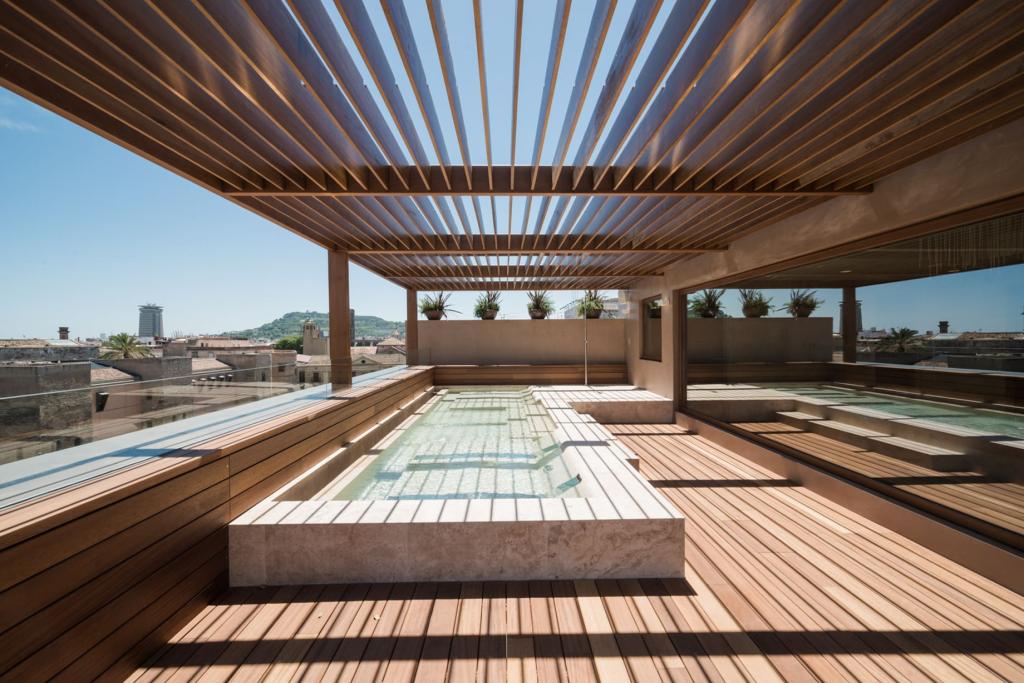
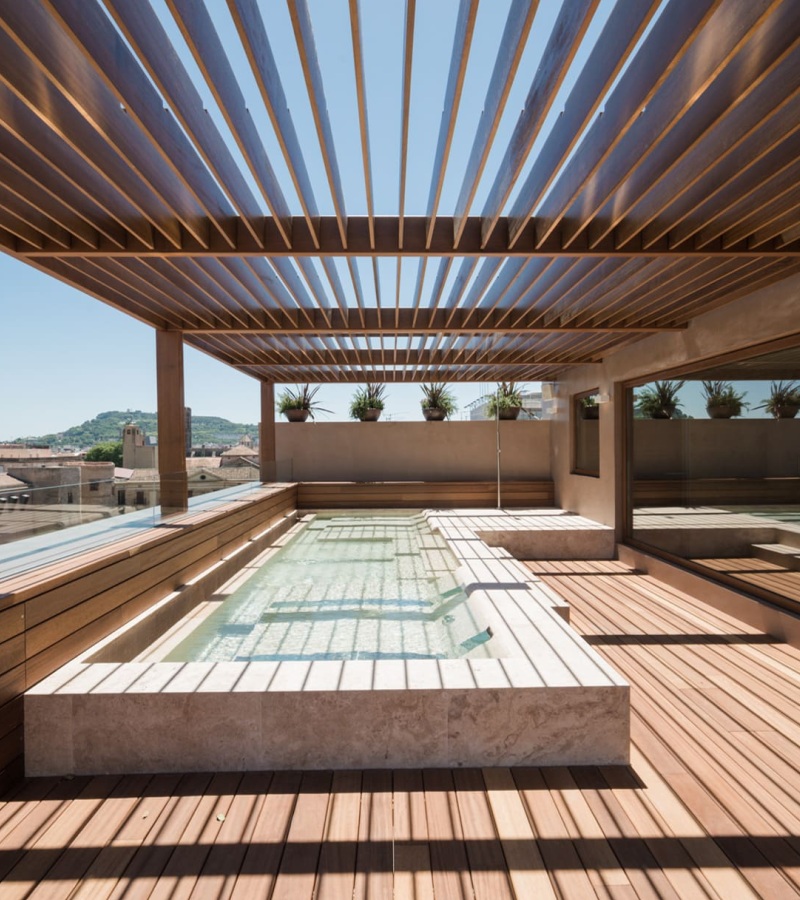
The wet circuit is the heart of the contemporary hotel spa. Sauna, steam bath, cold plunge, leisure pool, jacuzzi and sensory showers form the backbone of the sensory journey. The quality of the equipment, materials and architectural integration determines whether the result feels premium or merely functional.
The number and type of treatment rooms must respond to the hotel’s actual capacity and projected demand. Current trends prioritize double treatment rooms for couples, rooms with access to a terrace or garden in outdoor environments, and adaptable spaces that can host high-end treatments with specific equipment.
This is one of the most undervalued spaces in hotel spa design, and also one of the areas with the greatest impact on the perception of quality. The relaxation room is not a corridor with loungers: it is the space where the guest integrates the experience. Light, temperature, acoustics, aromas and materiality must work together with precision.
Today’s wellness guest does not separate exercise from wellbeing. The hotel gym has evolved into a conscious movement space that integrates high-performance equipment, yoga and meditation areas and, in some cases, personalized training programs. The architecture of these spaces must reflect that philosophy.
The wellness sector evolves at a speed that demands constant updating. Projects designed today must anticipate where the market will be in three to five years.
Cryotherapy, flotation chambers, red light therapy, massage beds with vibration technology and active recovery protocols are moving from specialized centers into leading hotel spas.
Spain has an underused thermal tradition within the hotel context. Projects that integrate thermalism principles receive an extraordinary response from Nordic, German and Anglo-Saxon markets.
Connection with nature is no longer a decorative element; it has become a structural principle of wellness design. Natural light, integrated vegetation, natural-origin materials and views of the surrounding environment are now requirements, not optional extras.
Leading hotel spas are incorporating biomarker analysis protocols, consultations with longevity specialists and personalized wellbeing programs. The guest is not only looking to relax, but also to optimize their wellbeing.
Investment funds and international hotel operators increasingly require spa projects to comply with sustainability standards, from material selection to energy and water management systems.
The profitability of a hotel spa is not guaranteed by the investment budget; it is built through design decisions. Projects that generate sustained returns share a series of principles that go beyond aesthetics.
An oversized spa generates operating costs that erode margins. An undersized spa limits revenue potential. Optimal sizing begins with a real analysis of hotel occupancy and guest profile.
The sequence in which the guest moves through the spa determines their perception of the experience. A poorly designed flow creates friction that no finish can compensate for.
Heating and climate control systems for saunas, steam baths and wet areas represent a significant part of operating costs. Equipment selection has a direct impact on EBITDA.
Materials and equipment must be selected not only for their initial appearance, but also for their long-term performance and ease of maintenance.
Spa design must also consider the team’s workflow: laundry, storage, service access and changing rooms. A spa that is well designed for the guest but poorly designed for the operator creates inefficiencies that affect service quality.
A well-executed hotel spa project requires precise coordination between disciplines: architecture, interior design, engineering, wellness expertise and project management. Companies specialized in the integral design and construction of spas provide an advantage that goes beyond finishes: they understand the product from within.
Definition of the hotel’s wellness positioning, analysis of the target guest, sizing of the program, integration with the existing or new-build architecture and projection of revenue and operating costs.
Development of the architectural and interior design project, selection of materials, specification of wellness equipment and design of installations: plumbing, electrical systems, climate control and acoustics, coordinated with the hotel’s systems.
Execution of works, installation of specialized wellness equipment — saunas, steam baths, pools and experience showers — and quality control. The specialization of the construction team in wellness infrastructure is decisive for the final result.
Commissioning of installations, training of the operational team, definition of the treatment menu and activation strategy. The opening of a hotel spa is also a communication opportunity and should be planned as such.
With more than 50 years of experience in the design, construction and equipment of luxury spas in Europe and Latin America, Freixanet Wellness supports hoteliers, architects and developers from conceptualization to opening, with a technical understanding of the wellness product that few companies can offer.
If you are developing a hotel or real estate project with a wellness component in Spain — whether in Mallorca, Madrid, the Canary Islands, Catalonia, the Costa del Sol, Andalusia or any other location in Spain or Europe — the Freixanet Wellness team can support you from the earliest planning stage.
Contact the project team at freixanetwellness.com
The cost of a hotel spa project varies depending on size, level of finish, technical complexity and location. Projects for 4- and 5-star boutique hotels in Spain can range from €500,000 to several million euros, including design, construction and equipment. The investment should always be analyzed in relation to the projected return and its impact on the asset’s positioning.
A premium hotel spa should include, at minimum: a thermal water circuit with sauna, steam bath, pool and contrast areas; individual and double treatment rooms; a relaxation area; premium changing rooms and a differentiated reception area. Higher-level projects also incorporate conscious fitness areas, meditation spaces, specialized treatment rooms and integrated outdoor areas.
A well-designed spa impacts hotel value in multiple ways: it increases ADR and RevPAR, extends the average length of stay, improves loyalty rates and generates direct revenue through services and treatments. In the hotel asset market, hotels with a high-quality wellness offer achieve higher valuation multiples.
A medium-scale hotel spa project can require between 12 and 24 months from conceptualization to opening, including design, permits, construction and commissioning. New-build projects integrated into the hotel can be developed in parallel with the main construction process, optimizing timelines.
The design and construction of wellness infrastructure requires specific technical knowledge: heating and steam installations for saunas and hammams, hydrotherapy systems, water treatment for pools and jacuzzis, acoustics for relaxation spaces and material specification for high-humidity and high-temperature environments. Specialized companies such as Freixanet Wellness also bring the wellness product knowledge required to design spaces that work operationally.
Yes. Freixanet Wellness has an international presence, with projects in Europe and Latin America. For projects in Mexico and the region, it operates through Freixanet Wellness Mexico. The experience gained in markets with different climates and guest profiles brings a global perspective that enriches each project.
Discover more of our projects here.